
The problem I kept hitting
I have 50 ideas a week. I ship maybe one.
The rest leak. Into Slack threads I never revisit. Voice memos I never transcribe. Browser tabs that become graveyards. Screenshots with no context.
It's not a productivity problem. It's an information loss problem, and it compounds. The pricing insight from Tuesday never meets the customer research from Thursday. The content strategy that would write itself never forms, because the pieces live in five apps that don't talk.
Solo founders feel this hardest. No team to pick up the thread. When an idea leaves your head and lands nowhere useful, it's gone.
What changed
Six months ago, running seven agents against a live codebase was a research paper. Today it's a Tuesday.
The tools got real. Tool use, multi-step reasoning, persistent memory. Claude Code made it possible to run agents against actual repos, APIs, and workflows — not chat, execution.
The cost collapsed. Seven agents on scheduled jobs cost less per month than a single freelancer invoice.
So the question shifted from "can one person run a company with AI?" to "what's the framework that makes it repeatable?"
What I built
Agent0 is a vault framework built on Obsidian and Claude Code — the operating system for a one-person company.
- 83 skills across 10 categories. Each is a structured instruction: what to do, what to read, where to save the output.
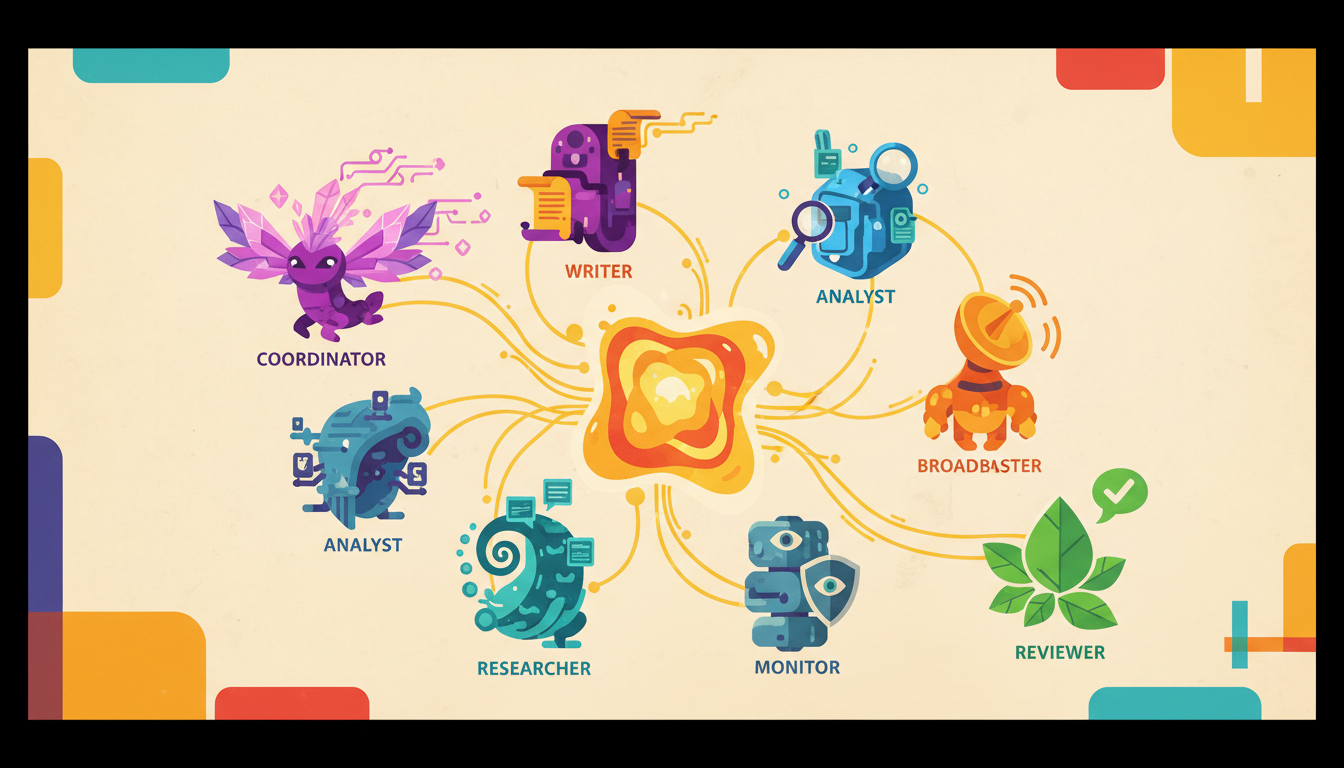
- 7 specialized agents. Cortex orchestrates, Loom writes, Radar finds opportunities, Hippocampus verifies claims, Signal distributes, Sentinel monitors, Axon reviews code. Each has scoped permissions and a personality.
- Human-in-the-middle governance. Every action is auto-execute or requires-approval. A rejection log teaches the system what I don't want. Trust expands over time.
- Local-first. Plain Markdown on my machine. No hosted DB. Syncs via GitHub. I own every file.
- Self-improving. Skills evolve with feedback. Persistent memory across sessions. Session 50 is smarter than session 1.
The repository is the proof: agent0.markops.ai. The vault, the agents, the skills, the docs are all live.
The market
Three curves are bending at the same time.
- Agentic AI is the category of the cycle. Analyst consensus puts the AI agents market at $28B–$65B by 2030, growing at 40–45% CAGR. Every frontier lab is shipping agent primitives. The infrastructure is being built in public.
- The solo economy is massive and underserved. ~28M non-employer businesses in the US. Creator economy on track for $480B by 2027. Globally, 300M+ self-employed. These people already pay for software — they just glue seven tools together to do one job.
- Personal knowledge management is a proven category with no agentic player. Notion is $10B+. Obsidian has >1M MAU. Neither has autonomous agents. Agent0 is the first framework that sits on top of a vault and does the work.
The intersection — personal vault × agentic execution × solo operator — is an open lane.
The business
I'm not selling software. I'm selling leverage.
- Starter ($129, one-time) — self-install framework, documentation, prompt library. Indie market.
- Pro ($269, one-time) — one-command setup, 7 agents pre-wired, bring your own LLM. Target: serious solo operators.
- Custom ($2K–$10K) — I set up the full vault + agents for founders and small teams. High-margin, conversion-heavy.
- Recurring (future) — hosted agent runtime, shared vault for small teams, skill marketplace. Recurring layer sits on an installed base.
Unit economics. Zero COGS on Starter/Pro (no infra until the recurring tier). LLM cost is passed through. Gross margin on the install base is effectively 100%.
Path to $10M ARR. At Pro price, that's ~37K customers. The Obsidian MAU base alone is 27x that. I don't need the whole market. I need a wedge.
What I'm sure about
- The system runs. First article published, 20 social posts scheduled, 44-page documentation site written by the agents themselves.
- The daily vault ritual is a production system, not a demo. Brain dump → agent standup → task review → memory update → git sync. Every session.
- The category is real, the timing is right, and the tools finally exist.
What I'm not sure about
I'd rather say this out loud than varnish it:
- Distribution. The product works for me. I don't yet know the wedge that makes it work for strangers who don't live inside Obsidian.
- Pricing. Starter/Pro tiers are a hypothesis, not a proven ladder. The Custom tier might eat the roadmap.
- Governance at scale. The approval matrix works when one human is in the loop. I don't know how it behaves when a team shares a vault.
- Moat. The skills are open patterns. The defensibility is the system, the compounding memory, and the brand — I'm still testing whether that's enough.
What I want from you
If you're reading this, one of these is probably true:
- You want to partner. Investor, co-builder, first real user. I'm raising a first round — but I'd rather have the conversation than the pitch. Push on the "not sure" list.
- You think I'm wrong. About the market, the architecture, the pricing, the moat. Good — tell me where. Disagreement beats applause.
- You want to use it. The alpha is live. Go break it and tell me what broke.
Any of those — I'm listening.
Maciek Marchlewski Founder, Agent0 LinkedIn